


CARBONATED DRINK & BEER PRODUCTION LINE
High-Precision Counter-Pressure Bottling Lines from A to Z. Engineered with Next-Gen Electronic Valve Technology to Achieve Ultra-Low Oxygen Pickup and Prevent Foaming.

video
Who It Is For
Craft / Traditional Brewery
Pain Points/Needs
- Beer foams very easily, leading to inaccurate liquid levels;
- Glass bottles are prone to shattering during bottling;
- It is necessary to ensure abundant foam.
Fillron Solution
We provide isobaric filling lines for glass bottles, equipped with precise level valves and liquid nitrogen dripping technology to ensure consistent liquid levels, abundant foam, and explosion-proof safety.
Carbonated Soft Drink / Soda
Pain Points/Needs
- Extremely high production capacity is required;
- PET bottle packaging must prevent CO₂ loss;
- And flavors need to be changed frequently.
Fillron Solution
We offer high-speed PET isobaric filling lines, equipped with high-efficiency carbonizers and quick-change wheels, achieving high output and low CO₂ loss.
RTD / Cider
Pain Points/Needs
- Packaging formats are varied (cans/irregularly shaped bottles);
- High requirements are placed on the filling environment.
Fillron Solution
An isobaric filling system compatible with various packaging containers, equipped with CIP automatic cleaning to ensure the hygiene and safety of fermented beverages.
Capacity & Scope

Applicable materials
Scope and Technical Parameters: Beer, carbonated drinks, soda water, premixed cocktails, cider
Description/Advantages: Compatible with beverages of different carbon content (CO₂ volume).

Applicable containers
Scope and Technical Parameters: PET bottles, glass bottles, and cans
Description/Advantages: Supports various packaging formats; offers customized isobaric filling valves.

Complete production line capacity
Scope and Technical Parameters:1,000 BPH – 24,000+ BPH
Description/Advantages: From craft beer production lines to industrial-grade high-speed lines, each stage is seamlessly integrated.

Carbonation Precision
Scope and Technical Parameters: CO₂ content control precision: ±0.05 g/L
Description/Advantages: The use of a high-efficiency venturi nozzle ensures uniform gas dissolution.

Filling Accuracy
Scope and Technical Parameters: Liquid level deviation ≤ ±1.5 mm
Description/Advantages: Isobaric, anti-drip filling valve ensures consistent product appearance and quality.
Line Process Flowchart
Water Chilling & CO2 Carbonator
Cool the beverage base to the optimal carbonation temperature and precisely inject CO₂ via a carbonator to achieve the target gas content.
Bottling Preparation
Glass bottle washer (hot water/alkaline solution cleaning) or PET bottle air-conveying unscrambler ensures containers enter the filling area clean.
Isobaric Counter-Pressure Filling Monobloc
Utilizing the isobaric principle, the bottle is first pressurized with CO₂ to match the pressure in the product tank; filling then proceeds smoothly via gravity or pressure differential, preventing foaming and CO₂ loss.
Crown/Screw Capping & Foaming Control
Precise capping/pressing; equipped with a liquid nitrogen dosing system or mechanical de-foaming mechanism to eliminate foam in the bottle neck and preserve the fill level and CO2 content.
Post-Packaging Automation
Bottle warming/drying (to prevent condensation), labeling/coding, film wrapping/case packing, and robotic palletizing for warehousing.
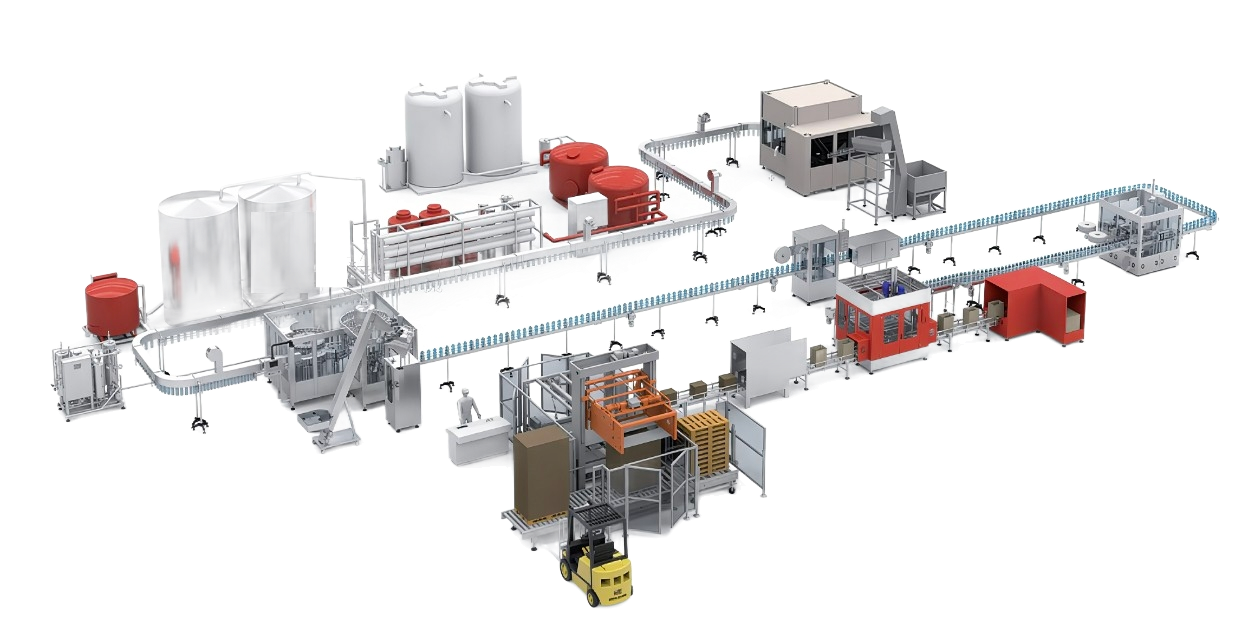
THE COMPLETE WORKFLOW BLUEPRINT
From CO2 Carbo-Cooling to Final Sealing. Click Each Phase Below to Explore Our Seamless Isobaric Filling Mechanics that Protect Drink Crispness.
01
Water Treatment System
01
Water Treatment System
Deaerates product water and chills it below 4°C, blending precisely with CO2 gas to ensure stable, high-volume carbonation.

02
Blending System
02
Blending System
High-pressure rinsing combined with double vacuum pre-evacuation (especially for beer) to flush out air and oxygen residues.
03
Automatic PET Bottle Blowing Machine
03
Automatic PET Bottle Blowing Machine
Advanced electronic filling valves ensure zero flavor loss, strict CO2 volume preservation, and bubble-free, high-precision level control.
04
Carbonated Drink Filling Machine
04
Carbonated Drink Filling Machine
Immediate capping with warm-water jet bubbling (for beer) to push out headspace air before crown corking or aluminum screw capping.
05
Post-Packaging Automation
05
Post-Packaging Automation
Warm-up tunnel (to avoid bottle condensation), OPP hot melt glue labeling, automatic pack wrapping, and robotic palletizing.
06
CO2 Mixer
06
CO2 Mixer
Warm-up tunnel (to avoid bottle condensation), OPP hot melt glue labeling, automatic pack wrapping, and robotic palletizing.
07
Warming Tunnel
07
Warming Tunnel
Warm-up tunnel (to avoid bottle condensation), OPP hot melt glue labeling, automatic pack wrapping, and robotic palletizing.
Plant & Utility Requirements
Facility Space and Cleanliness
- Space: Space needs to be reserved for a carbonator, liquid nitrogen storage tank and flask warmer.
- Cleanliness: The filling room must meet the Class 10,000 cleanliness standard and maintain a positive pressure state.
Refrigeration and Temperature Control
- Key Requirement:The carbonation effect is highly dependent on low temperature.
- An industrial chiller unit is required to ensure that the temperature of the beverage base liquid is reduced to 2°C-5°C.
Compressed Gases
- CO₂ Supply: High-purity, food-grade CO₂ storage tanks and pressure-reducing valves are required.
- Compressed Air: A refrigerated air dryer is required to ensure pneumatic components remain free of water and oil.
Electricity and Steam
- Electricity: 380V / 50Hz / 3-phase.
- Steam/Hot Water: Used in glass bottle washing and subsequent bottle warming machines, requires a boiler or hot water system.
Configuration & Options
| Standard Economy | High-Efficiency Automatic | Premium Craft / Industrial |
| 1,000 - 4,000 BPH | 5,000 - 15,000 BPH | 16,000 - 24,000+ BPH |
| Basic carbonator + isobaric filling machine; mechanical defoaming; basic end-of-line packaging. | High-efficiency carbonator + high-speed isobaric filling machine; liquid nitrogen dosing system; bottle warmer + air knife. | Electronic isobaric filling machine; in-line visual inspection for CO₂ levels and fill levels; fully automated high-speed production lines for cans and glass bottles. |
| Suitable for: Craft brewery startups and small-scale soft drink brands. | Suitable for: Medium-to-large breweries and mainstream carbonated beverage brands. | Suitable for: Leading beer groups and large-scale beverage enterprises. |
Turnkey Project Steps

01
Analysis of Beverage Characteristics and Process Confirmation
Determine the isobaric filling scheme and carbonation process based on the beverage's CO₂ volume, viscosity, and packaging material.

02
Overall Line Layout Design
Focus on planning the CO₂ gas supply lines, the chilled water circulation system, and the electrical layout for explosion-proof zones.

03
Equipment Manufacturing and FAT
In-factory testing with gas is conducted to verify the sealing performance and anti-foaming effectiveness of the isobaric valve.

04
On-site Installation and SAT Commissioning
Engineers perform on-site installation and assist with gas content testing and liquid level calibration to ensure the production line meets standards.

05
Training and Lifetime After-Sales Support
Training on isobaric filling processes and equipment maintenance; 24-hour online technical support and lifetime spare parts supply.
Customize Your Production Line
 20000BPH PET Bottle Carbonated Drink LineThe line offers high capacity and excellent automation, with stable and accurate PET bottle filling.Inquire Now

 15000BPH Carbonated Drink Production LineThe line remains stable during high-speed production, delivering efficient filling and consistent product quality.Inquire Now
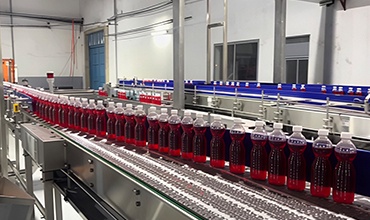
 12000BPH CSD Drink Production Line for PET BottlesPET bottle handling and filling are smooth and stable, with excellent carbonation control and reliable output.Inquire Now
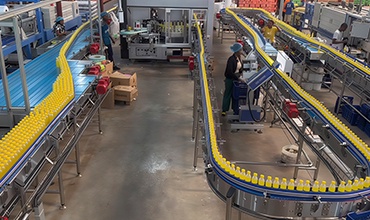
 10000BPH Soda Drink Production LineThe line runs efficiently with accurate filling, ensuring consistent soda drink quality.Inquire Now

FAQ
What is "isobaric filling," and why is it essential for carbonated beverages?
Isobaric filling involves pressurizing an empty bottle with CO₂ gas before filling so that the internal pressure of the bottle matches the pressure within the liquid reservoir. Only when the pressures are balanced can the valve be opened to allow the liquid to flow smoothly into the bottle under gravity. Without isobaric filling, a high-pressure carbonated beverage exposed to atmospheric pressure would instantly foam up violently and gush out, making filling impossible and resulting in a massive loss of CO₂.
What should be done if excessive foaming during filling leads to inaccurate liquid levels?
Fillron’s isobaric filling machines are equipped with multiple anti-foaming mechanisms: first, precise control via pre-vacuum and pre-pressurization sequences; second, an optional liquid nitrogen dosing system that injects liquid nitrogen before capping to displace air in the bottle neck and eliminate foam; and third, a mechanical de-foaming mechanism. These technologies ensure consistent liquid fill levels.
Why is the beverage flat and lacking carbonation due to poor carbonation?
The carbonation effect is mainly affected by temperature and pressure. The beverage base liquid must be cooled to 2°C-5°C by a chiller; the lower the temperature, the higher the CO₂ solubility. Simultaneously, the pressure inside the carbonator must be stable. Fillron's carbonators are equipped with an online CO₂ analyzer, which automatically adjusts the gas intake to ensure accurate carbonation levels.
Is it safe to fill carbonated beverages into glass bottles? Is there a risk of the bottles exploding?
It is very safe, provided the equipment is properly calibrated. Fillron’s glass bottle isobaric filling lines subject bottles to rigorous flaw detection and cleaning before they enter the filling stage; the pressure during filling is precisely controlled to remain stable, preventing sudden pressure spikes. Furthermore, our capping process utilizes constant-torque screw capping or press-capping to ensure a tight, uniform seal, thereby eliminating the risk of bottle bursts.
In summer, high workshop temperatures cause condensation to form on the bottles after filling, making it difficult for labels to adhere properly. What is the solution?
This is a common occurrence with the cold filling of carbonated beverages. Fillron includes a bottle warming machine (warm water spray tunnel) as standard equipment on the downstream packaging line; this system uses circulating warm water to raise the bottle temperature to ambient levels and eliminate condensation, followed by powerful air knives to dry the bottles, ensuring secure label adhesion and dry outer packaging.
Is Fillron’s isobaric filling machine compatible with both glass and PET bottles?
Yes. Fillron offers a highly modular integrated isobaric filling machine; by simply swapping out a few components—such as starwheels, guide plates, and filling valve assemblies—the same main unit can handle production for both glass and PET bottles, significantly reducing the customer's equipment investment costs.
Contact Us
Complete 2 easy steps below to get your factory matrix and a complimentary factory layout design within 24 hours.
Request Factory Price & Factory Layout Within 24h
Request Factory Price & Factory Layout Within 24h